
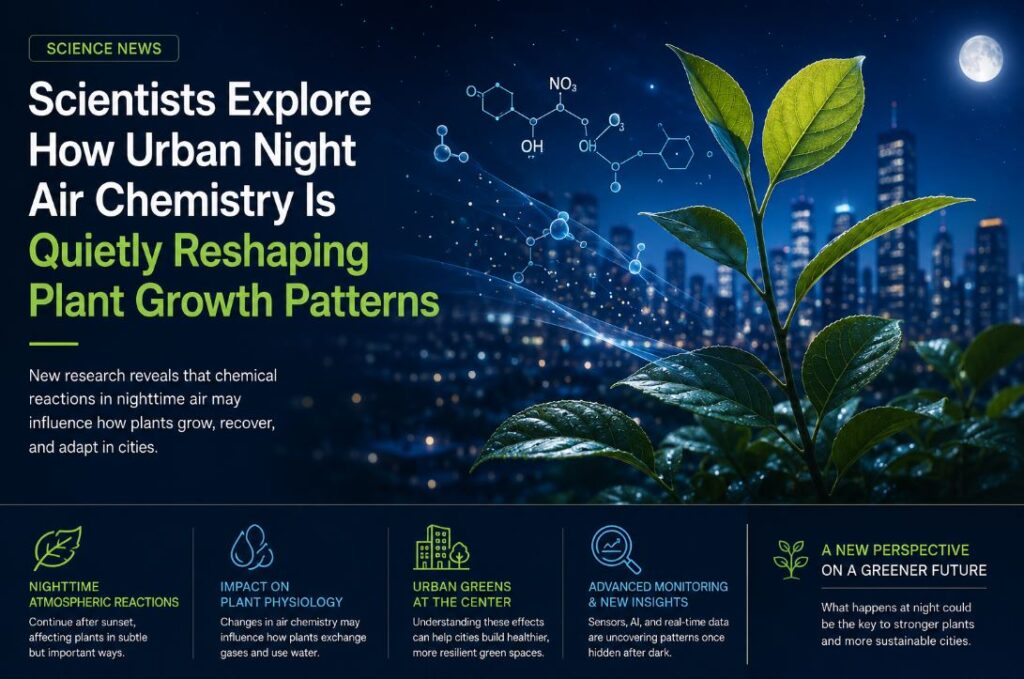
Falls Church, VA / 500NewsWire / July 7, 2026 / As cities continue to expand, scientists are taking a closer look at an environmental change that has received far less attention than traffic, heat, or air pollution. New research efforts are focusing on how the chemistry of urban air after sunset may be quietly influencing the way plants grow, recover, and interact with their surroundings.
For decades, most studies of air quality have concentrated on daytime conditions, when sunlight drives many chemical reactions in the atmosphere. However, researchers now believe that nighttime air chemistry deserves equal attention because it creates a different set of environmental conditions that may directly affect urban vegetation.
During the night, temperatures often fall, humidity rises, and pollutants behave differently than they do during the day. Nitrogen compounds, ozone, and tiny airborne particles continue to react with each other even without sunlight. Scientists say these subtle changes may alter the environment around leaves, roots, and soil in ways that are only beginning to be understood.
Urban plants, including trees, shrubs, and community gardens, play a vital role in improving city life. They absorb carbon dioxide, filter airborne particles, reduce heat, and provide habitats for birds and insects. If nighttime atmospheric conditions are changing how these plants grow, researchers believe the findings could influence future urban planning and environmental management.
Several research teams are now combining environmental sensors with satellite observations and plant monitoring systems to collect overnight data. Unlike traditional studies that rely heavily on daytime measurements, these projects are tracking changes hour by hour to identify patterns that were previously overlooked.
Early observations suggest that some plants may keep their leaf pores, known as stomata, open for different lengths of time depending on local air chemistry. These tiny openings regulate the exchange of gases and water between plants and the atmosphere. Even small changes in their behavior could affect growth rates, water use, and resilience during periods of drought or heat.
Scientists are also investigating whether nighttime chemical reactions influence plant recovery after exposure to daytime stress. Trees growing along busy roads, for example, experience repeated exposure to vehicle emissions. Understanding how nighttime conditions either support or hinder recovery could help cities select tree species better suited to urban environments.
The research may also improve climate adaptation strategies. As many cities invest in green infrastructure to reduce rising temperatures and improve air quality, knowing which plants perform best under local atmospheric conditions could make these projects more effective. Better data may also help landscape designers choose vegetation that remains healthier over longer periods while requiring less maintenance.
Environmental experts believe this field of research is still in its early stages, but advances in sensor technology are accelerating progress. Modern air-quality monitors are now small enough to be installed throughout parks, rooftops, and green corridors, allowing researchers to capture detailed information throughout the night. Artificial intelligence is also helping scientists analyze millions of data points to identify relationships that would have been difficult to detect just a few years ago.
The growing interest in nighttime atmospheric science reflects a broader shift toward understanding cities as dynamic ecosystems that operate around the clock. Rather than viewing plants as passive elements of the urban landscape, researchers are beginning to see them as active participants that respond continuously to changing environmental conditions.
Although many questions remain unanswered, scientists agree that studying urban night air chemistry could provide valuable insights into healthier cities and more resilient green spaces. As research expands across different climates and regions, the findings may help shape future decisions on urban forestry, environmental conservation, and sustainable city development.
What happens after sunset has long remained one of the least explored chapters of urban environmental science. Today, that chapter is beginning to open, revealing that the quiet hours of the night may have a much larger influence on plant life than previously imagined.