
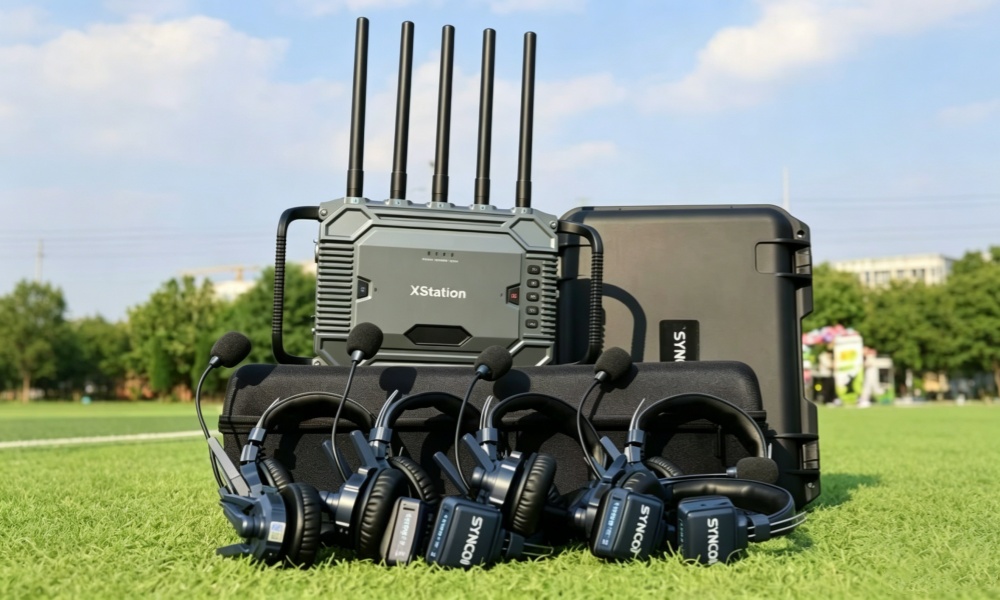
I was helping on a live show last year when the crew grew from six people to twenty in one week. At first, everyone could hear everyone else. By the second rehearsal, the channel was a mess. The lighting team talked over the camera team, the stage manager could not get a word in, and two people kept repeating the same cue because they thought no one had heard it. The problem was not the people. It was the lack of a center. What we needed was a wireless intercom base station to keep communication organized as the team grew. A big team needs a way to split the talk, so the right people hear the right message at the right time.
When Headsets Alone Are Not Enough
For a small crew, headsets alone are enough. You power on, you talk, you listen, and the day moves. When the team grows, that simple pattern starts to strain. More voices mean more overlap, more confusion, and more missed cues.
A wireless intercom base station gives that growing team a center. It holds the network together, keeps groups organized, and lets the lead hear across groups while each team stays focused on its own channel. The crew does not have to talk louder. They just have to talk in the right place.
I felt this shift on that live show. Once we had a center, the lighting team could solve a problem without distracting the camera team. The stage manager could call a hold to everyone, or speak quietly to one group. The noise dropped, not because people stopped talking, but because the talk finally had a shape.
A Base That Moves With the Team
A mobile intercom base station is built for jobs that do not stay in one room. It can sit on a tripod at a sports field, ride in a production cart, or stand on a table at a conference. It runs on battery or wall power, and it keeps the network steady while the team moves. I watched a crew set one up on a grass field in under ten minutes. They placed it high, powered it on, and the whole field came alive with clear talk. No cables across the ground, no fixed room, just a small hub that moved where the work moved.
Mobility also means you can place the hub where the signal is best, not where the wall outlet happens to be. A high spot, a clear line of sight, and a stable base make a bigger difference than any extra setting.
Talking to Older Systems
Many venues already have wired systems in place. A wireless 4 wire intercom base station bridges the old and the new. It connects to a wired setup through a standard four wire interface, so the wireless team can talk with the wired team without a translator in the middle. The pin layout can be flipped with a small switch to match different standards, which saves a long troubleshooting session. I have seen this matter most in theatres and stadiums, where the house crew has used the same wired setup for years. They do not want to replace it. They want the new team to join it, and a good base makes that join feel simple.
The best part is that no one has to learn a new language. The wired crew keeps their habits, the wireless crew keeps theirs, and the base carries the conversation between them.
Headsets Still Matter
A base is only useful if the headsets on the edge are comfortable and clear. Choose wireless two-way communication headsets that are light enough for a long day, clear enough for a noisy hall, and simple enough for a new volunteer to put on and start communicating in seconds. I have handed headsets to people who had never used one before. The ones who kept talking were the ones who forgot they were wearing it. The ones who struggled were the ones who kept adjusting the fit or asking to repeat. Comfort and clarity are not extras. They are the whole job.
Good headsets also handle noise well. They lift the voice above crowd hum, wind, and machine noise, so the person on the other end hears words, not a roar. That clarity keeps people calm, because they trust what they hear.
The Hub in the Middle
At the center of a larger setup, a wireless intercom base station does more than relay voices. It organizes the team into groups, so the director group, the camera group, and the audio group can each talk without stepping on each other. Group leads can hear across groups, while members stay on their own channel. It also carries program audio, so the team can hear the show while they coordinate the next cue. A single hub can support a team of twenty, and two hubs linked together can support a team of forty. That scale lets a small show grow into a large production without rebuilding the whole communication plan.
Control matters too. An app lets the lead adjust groups, routing, and volume from one screen, and keep the system current with updates. When the plan changes mid show, the lead can reshape the groups without gathering everyone for a huddle.
Scaling Without Shouting
A wireless headset intercom system grows best when it grows in steps. You start with a few headsets for a small crew. You add a base when the team grows. You add a second base when the venue stretches across a field or two halls. At each step, the feel stays the same. Power on, join, talk. The team does not need a new ritual at each size. That steady feel is what makes a system trustworthy. People use it because it stays simple, even as the job gets bigger.
Range grows with the base as well. One hub covers a solid area for a single stage. Two hubs linked by cable stretch the coverage across a much larger site, so a team can coordinate from the stage to the far gate without losing touch.
The Other Half of the Pair
The base works best when paired with headsets that match its approach. Wireless two-way communication headsets that join without a fixed lead unit keep the network flexible. Each headset acts as its own node, the network heals itself if a unit drops out, and new units join in seconds. The team can split into groups for parallel work, switch to a single call for a big cue, or open a private one to one chat for a quiet correction. That flexibility is the reason a base and a good headset set belong together. One gives the team a center. The other gives each person a clear voice.
I think of it like a good stage crew. The base is the stage manager, calm and central. The headsets are the crew, each focused, each heard. When both work, the show feels easy, even when the audience never sees the effort.
A Calmer Way to Run a Big Day
If your team is growing, start with the moment when talk broke down. Was it overlap, was it distance, or was it a group that could not hear its own channel. A wireless intercom base station fixes that moment by giving talk a center and a shape. It does not make the work quieter. It makes the talk clearer, so people can focus on the work they came to do. And when the talk is clear, the whole day feels calmer, even when the crowd is loud and t