


For Indian national founders, engineers and researchers by whom an approved EB-2 National Interest Waiver petition is held, a narrow operational window is presented by the November 2026 Visa Bulletin. The Dates for Filing cutoff for EB-2 India is January 15, 2015. The Final Action Date is November 1, 2013. It has been confirmed by USCIS that the Dates for Filing chart must be used by employment-based applicants for I-485 submissions in November 2026.
Two distinct legal functions are served by these two dates. Filing errors that can be delayed by months or years are produced when they are confused.
The November 2026 EB-2 India Cutoffs: What the Bulletin Establishes
Two separate charts are published each month by the Department of State. For EB-2 India in November 2026:
Filing is permitted by a priority date earlier than January 15, 2015. Approval is permitted by a priority date earlier than November 1, 2013. An extended period of pending status, during which employment authorization and advance parole may be obtained and the adjustment application remains pending before it can be adjudicated to completion by the agency, is meant by the fourteen-month gap between these cutoffs.
A separate queue is not assigned to EB-2 NIW petitions. The same EB-2 India cutoffs as employer-sponsored EB-2 cases are used by them. The basis of the I-140 approval is affected by the NIW classification; visa availability is not altered by it.
Dates for Filing vs. Final Action Dates: A Procedural Distinction with Material Consequences
The submission of Form I-485 to USCIS is governed by the Dates for Filing chart. Eligibility to request an Employment Authorization Document (Form I-765) and Advance Parole (Form I-131) is triggered when filing is made under this chart.
For India-born applicants in H-1B status by whom extended backlogs are faced, the first point at which employment authorization becomes independent of a specific petitioning employer is represented by this.
The approval of the pending I-485 by USCIS is governed by the Final Action Date chart. Until the priority date is advanced past the Final Action cutoff, authority to grant permanent residence is lacked by the agency. The application remains pending, with associated work and travel benefits, but no green card is issued.
The chart to be applied each month is designated by USCIS based on anticipated visa availability. For November 2026, the Dates for Filing chart has been designated by the agency for all employment-based preference categories. This designation is month-specific. The USCIS filing chart page should be verified by applicants before any I-485 package is submitted.
Eligibility to File Under the November Chart: Beyond the Priority Date
One requirement is satisfied by a priority date earlier than January 15, 2015. Eligibility for adjustment of status is not established by it.
Physical presence in the United States, maintenance of lawful nonimmigrant status, and the absence of statutory bars under INA § 245 are required for Form I-485. An approved I-140 is required as a prerequisite for the adjustment application. For India-born EB-2 applicants, concurrent filing of I-140 and I-485 is rarely available because the priority date must be current under the applicable chart at the time of I-140 submission; a condition that is generally precluded by the India backlog.
The date on which the I-140 was properly filed with USCIS is the source from which the priority date itself is derived. Under 8 CFR 204.5(e), a priority date that may be retained for use with a subsequently approved petition in the same or a different employment-based preference category is conferred by an approved EB-1, EB-2, or EB-3 petition, provided the original approval was not revoked for fraud, willful misrepresentation, or material error. This retention provision is significant for researchers by whom institutions are moved between or founders by whom employers are changed: the earliest established priority date is followed by the beneficiary, not by the petitioning employer.
The Structural Context: Why the India EB-2 Queue Persists
Any single country is limited to seven percent of the total employment-based and family-sponsored visa allocation by the per-country ceiling under INA § 202(a)(2). This ceiling has been exceeded by India’s EB-2 demand for more than a decade. It was confirmed by the Department of State that all available EB-2 visas chargeable to India for FY 2026 were exhausted before the fiscal year ended, rendering the category unavailable from July through September 2026. Numbers were returned in October with the new fiscal year, but the structural imbalance remains unaddressed.
For NIW petitioners, a specific implication is made by this: the earliest possible priority date is primarily secured by the value of an approved I-140. Visa availability is not accelerated by the petition itself. The date that determines when the beneficiary may eventually file and obtain approval is locked by it. An NIW approval in 2026 with a priority date of 2026 places the petitioner approximately eleven years behind the November 2026 Dates for Filing cutoff—a figure that underscores the importance of the I-140 being filed as early as circumstances permit, and of that date being retained through subsequent job changes.
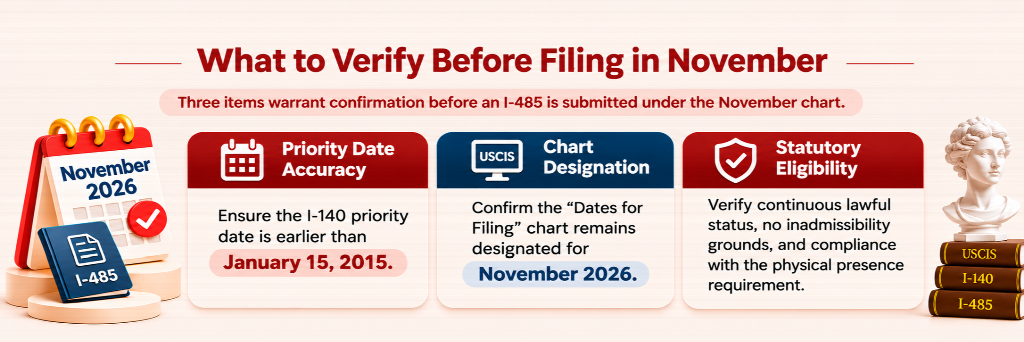
What to Verify Before Filing in November
Three items warrant confirmation before an I-485 is submitted under the November chart:
Priority date accuracy: Confirmation should be made that the date on the I-140 approval notice is earlier than January 15, 2015. If the priority date is derived from a labor certification, the filing date of the certification is controlled by it.
Chart designation: Verification should be made on the USCIS adjustment of status filing chart page that the Dates for Filing chart remains designated for November 2026. Designation is occasionally changed by the agency mid-month in response to demand fluctuations.
Statutory eligibility: Continuous lawful status, absence of inadmissibility grounds, and compliance with the physical presence requirement should be confirmed. Prior status violations, even brief ones, may require analysis before filing is made.
Why SiliconPath Law?
Individual circumstances and documentation are reviewed by SiliconPath Law to assess priority date position, identify potential eligibility issues, and determine whether filing is available under the current chart. A case evaluation is appropriate for applicants by whom uncertainty is held whether their date clears the November cutoff or whether adjustment is permitted by their immigration history.
Attorney Advertising Disclaimer: General information about published Visa Bulletin data is provided by this article and legal advice is not constituted by it, nor is an attorney-client relationship created by it. Immigration law and visa availability change frequently. Individual circumstances vary, and a similar outcome is not guaranteed by prior results. A qualified immigration attorney should be consulted regarding your specific situation before any action is taken.