

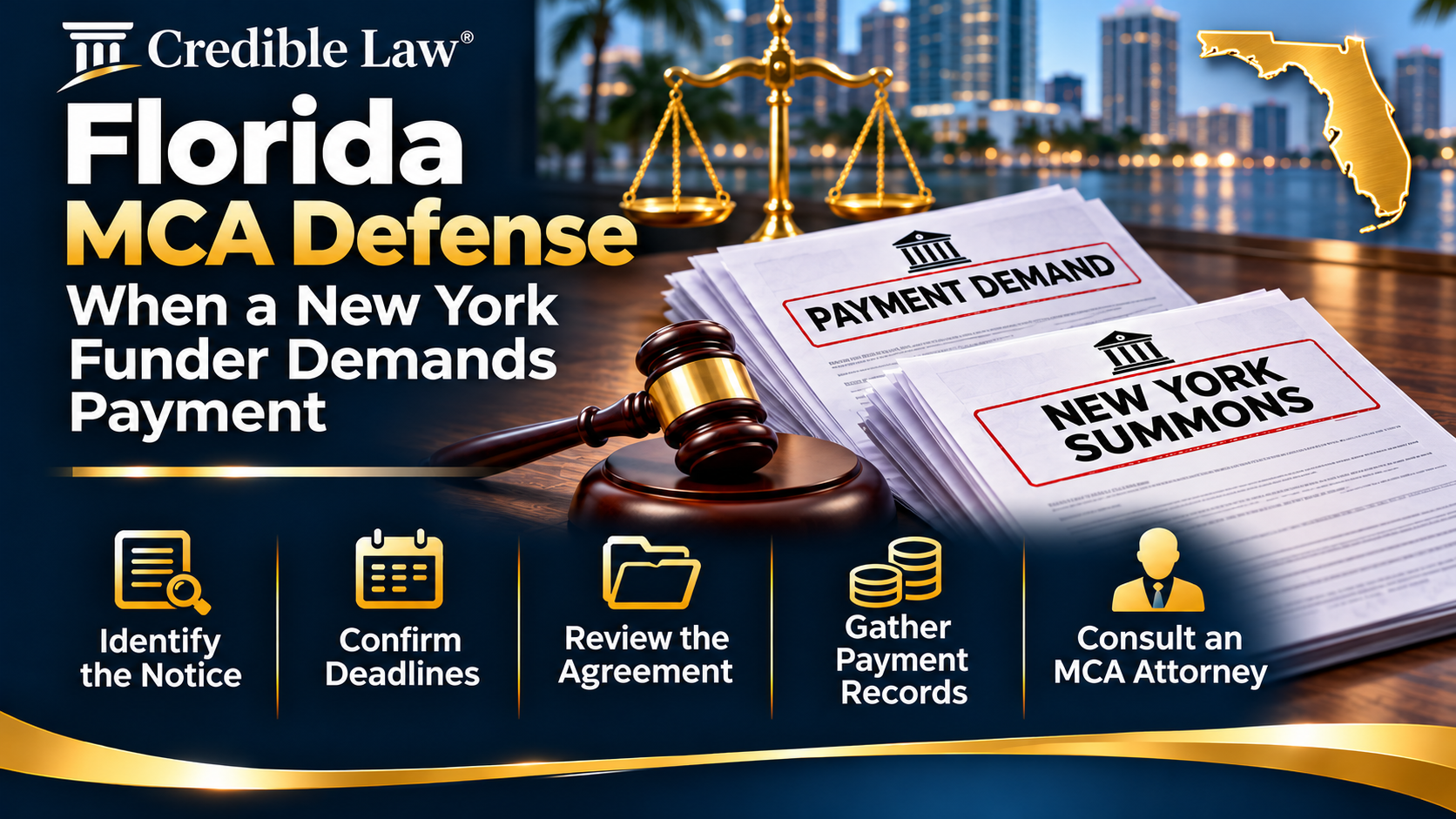
The legal information and attorney referral network outlines how Florida businesses can identify the stage of a merchant cash advance dispute, document payment adjustments and prepare for independent legal review.
Phoenix, Arizona / 500NewsWire / November 23, 2026 / Credible Law, a national legal information and attorney referral network, is highlighting its Florida MCA defense resources for business owners who receive a payment demand or court papers from a New York merchant cash advance funder. The guidance explains how to identify what has been filed, which court or agency appears on the notice and what records can help an independent attorney evaluate the dispute.
For a Florida business, the first question is often whether a funder can pursue it in New York. A New York court clause can matter, but the procedural stage matters too. A demand for payment, a summons in a New York action and a notice that an out-of-state judgment was recorded in Florida each raise different questions. A business may also receive correspondence naming the company and an owner who signed a personal guaranty. Confirming who is named and what document was delivered gives counsel a starting point for determining which obligations and deadlines apply.
Credible Law’s guide to Florida merchant cash advance laws provides background on funding agreements, Florida’s commercial financing rules and the enforcement of out-of-state judgments. The release focuses on what an owner can verify before responding to a demand or discussing repayment terms.
Identify what the funder has actually sent
A payment demand or default notice may state that the funder considers the agreement in default, identify an amount due or request a response by a certain date. Owners can preserve the full communication and compare the amount claimed with their own payment records. If the notice refers to a court case, owners can record the court name, filing number and parties listed so counsel can check the docket.
A summons or complaint raises a separate set of questions. Owners can save the complete documents, any envelope or delivery record, and the date and manner in which they received them. Counsel can review the court’s rules and the service record to determine the applicable response deadline. If the business is discussing a settlement, it can ask counsel to confirm whether a court deadline is still running while those discussions continue.
A notice involving an existing judgment calls for checking both the issuing court and any Florida record. Under Florida’s Enforcement of Foreign Judgments Act, qualifying judgments from other U.S. jurisdictions can be recorded in Florida. The statute sets out notice and timing requirements for enforcement through that process. The original judgment, the Florida recording details and the accompanying notices help counsel determine what stage the matter has reached.
Review the contract alongside the bank and sales records
A merchant cash advance dispute can turn on details spread across several documents. The master agreement may contain a forum-selection clause, while an addendum sets out how payments are calculated and a separate guaranty identifies the obligations an owner agreed to undertake. Counsel can review those documents together to determine where a claim may be heard, what law may apply and how the funder calculated the balance it is seeking.
A Florida business whose sales fell can also look for a reconciliation provision, which may describe how to request an adjustment when actual receipts differ from the assumptions used to set remittances. If the business sent a request, useful records include the request itself, the sales reports or statements provided, the funder’s response and any subsequent change to withdrawals. Those records give counsel a way to compare what the agreement says with what happened in practice.
Consider a Florida restaurant that received a demand after a slow month. The owner says the restaurant asked for lower remittances, and the funder says it never received the required records. Dated emails, the attachments originally sent and the corresponding bank statements can help clarify what was submitted and whether withdrawals changed. If the demand also names the owner individually, the signed guaranty can help counsel assess the claim against the owner separately from the claim against the business.
What to bring to a Florida MCA defense review
- The complete demand, summons or judgment notice. Include delivery details, court and case numbers, and all attachments.
- The signed funding agreement and guaranty. Include amendments, renewals and any payment authorization or reconciliation terms.
- A record of payments and receipts. Gather relevant bank statements, sales reports and the funder’s itemization of the balance, if available.
- Correspondence about payment adjustments or settlement. Preserve each request, the records you supplied and the funder’s replies.
- A dated timeline. Note when the agreement was signed, when payments changed, when papers arrived and which deadlines you can confirm.
With those records, an MCA defense attorney can assess the stage of the dispute, identify which jurisdictions are involved and explain whether counsel admitted in another state may be needed. The owner can also ask what needs immediate attention and which contract or payment questions require further review.
About Credible Law
Credible Law is a San Diego-based national legal information and attorney referral network. It publishes educational resources on merchant cash advance disputes, commercial collections and business litigation and connects business owners with independent attorneys. Credible Law is not a law firm. Independent attorneys provide legal advice and representation through their own engagements.
Media Contact
Kevin Leonard
Credible Law
https://crediblelaw.com/
(888) 201-0441
contact@crediblelaw.com