

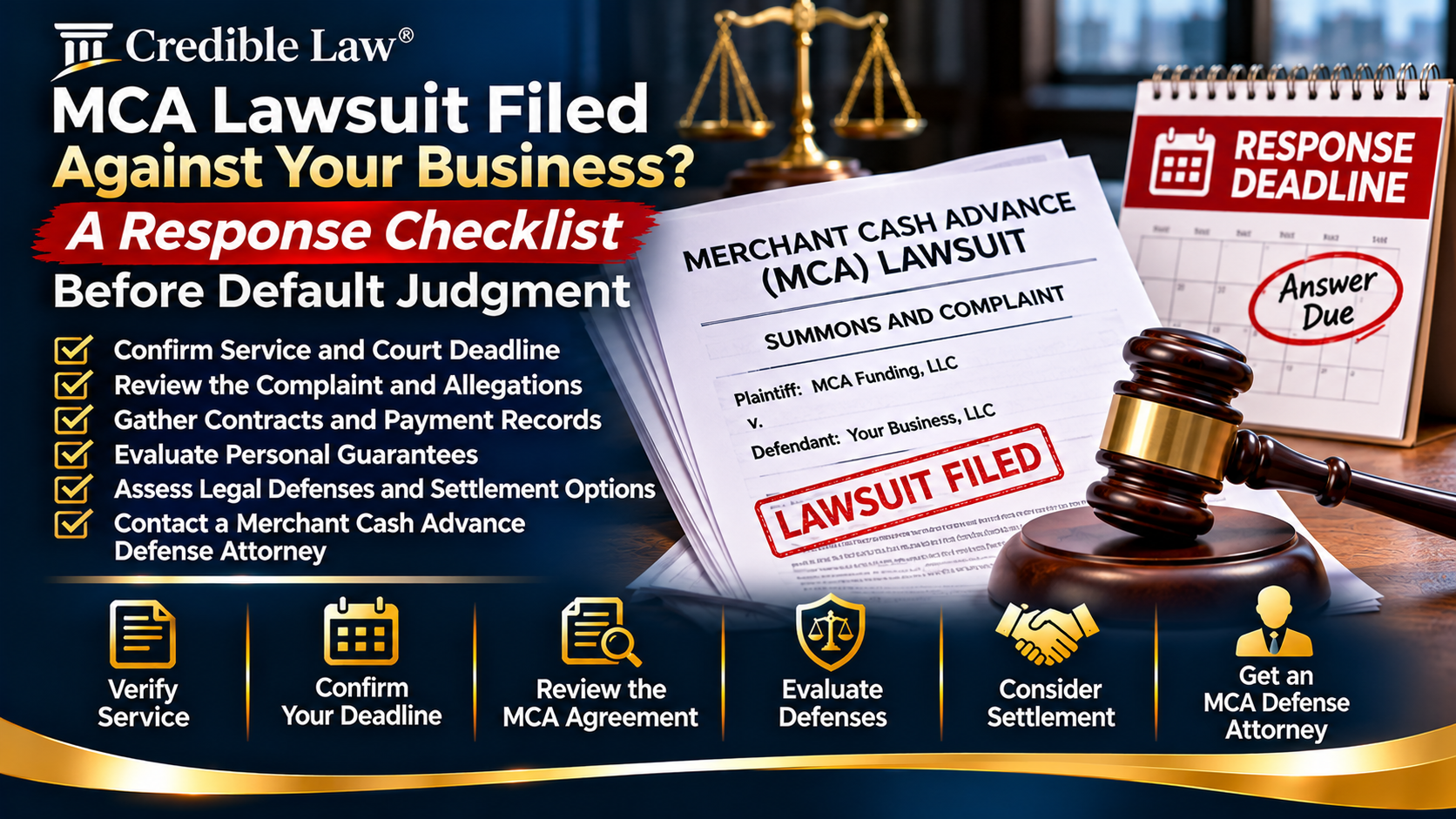
Credible Law outlines critical steps for business owners served with merchant cash advance lawsuits, including verifying service, identifying court deadlines, reviewing personal guarantees, preserving financial records, and evaluating available legal defenses before a default judgment is entered.
San Diego, California / 500NewsWire / November 24, 2026 — A business owner opens an envelope containing a summons and complaint from a merchant cash advance company. The funding provider alleges breach of contract, demands payment of an outstanding balance, and may seek to enforce a personal guarantee.
For the business owner, the immediate questions are often straightforward: How long is there to respond? Can the creditor freeze the company’s bank account? Is the amount claimed accurate? And what happens if the lawsuit is ignored?
The answers depend on the court, the agreement, the method of service, and the applicable law.
Credible Law, a national legal information and attorney referral resource, is highlighting the steps businesses should consider after receiving an MCA lawsuit, particularly when a response deadline is approaching.
Merchant cash advance litigation can involve disputed payment histories, reconciliation provisions, default allegations, personal guarantees, security interests, and lawsuits filed outside the state where the business operates.
However, receiving a summons does not mean the funding company has already won its case.
A complaint contains allegations that generally must be established through the applicable legal process. A defendant may have grounds to dispute some or all of those allegations.
The most immediate risk is allowing a response deadline to pass without taking appropriate action.
Depending on the jurisdiction and circumstances, failing to respond may permit the creditor to seek a default judgment, potentially opening the door to additional collection and enforcement proceedings.
What Happens When an MCA Company Files a Lawsuit?
A merchant cash advance lawsuit is a civil legal action in which a funding provider seeks relief related to an alleged violation of an MCA agreement or another legally recognized claim.
The complaint may allege that the business:
- Failed to deliver required receivables or remittances.
- Blocked or interrupted authorized ACH withdrawals.
- Changed its designated deposit account contrary to contractual requirements.
- Failed to provide requested financial documentation.
- Violated an agreement involving purchased receivables.
- Triggered a contractual event of default.
- Owes an accelerated balance or other claimed damages.
Some lawsuits also name individual business owners who signed personal guarantees.
The creditor may seek monetary damages, interest where legally recoverable, contractual fees, or other relief.
But the filing of a complaint does not automatically establish that the alleged default occurred, that the requested amount is correct, or that every contractual provision is enforceable.
The business must evaluate the actual legal documents and respond through the applicable court process.
MCA Lawsuit Response Checklist: 10 Steps Before Default Judgment
1. Identify the Court, Case Number, and Parties
Begin by examining the summons and complaint.
Identify the court in which the lawsuit was filed, the case number, the plaintiff, and every named defendant.
A lawsuit may name the business entity, one or more individual guarantors, or additional parties.
This distinction matters because each defendant may have separate legal obligations and response requirements.
Verify whether the papers identify a New York court, a court in the business’s home state, or another jurisdiction.
Preserve the complete document package, including envelopes, attachments, and proof-of-service materials when available.
2. Confirm How and When the Lawsuit Was Served
Service of process is the procedure used to provide formal notice of a legal action.
The requirements vary by jurisdiction, type of defendant, and method of service.
For example, service on a corporation or limited liability company may involve a registered agent, designated representative, or another legally authorized recipient.
Service on an individual guarantor may be governed by different rules.
The date and manner of service can affect the deadline for responding.
Business owners should document when the papers were received, who accepted them, and how they were delivered.
If service appears defective, qualified counsel can evaluate whether an objection is available.
An alleged service defect should not be treated as permission to ignore a pending lawsuit.
3. Calculate the Actual Response Deadline
One of the most consequential steps after receiving an MCA lawsuit is identifying the correct deadline.
Response periods are not uniform nationwide.
In many ordinary California civil actions, a defendant generally has 30 days after service to respond, subject to applicable exceptions.
In New York, certain civil actions require a response within 20 or 30 days depending on the method and circumstances of service.
Other states and courts use different rules.
Federal court proceedings may also have different deadlines.
These examples are not a substitute for reviewing the summons, governing procedural rules, and any court orders.
A business should not rely on a general internet article to calculate a deadline in a pending case.
Informal settlement discussions generally do not extend a court deadline unless an applicable rule, enforceable agreement, or court order provides otherwise.
4. Preserve the MCA Agreement and Financial Evidence
The original merchant cash advance agreement is often central to the dispute.
The business should preserve the complete contract, including amendments, exhibits, payment authorizations, guarantees, and related documents.
Other relevant records may include:
- Funding confirmations and net disbursement records.
- Business bank statements.
- ACH withdrawal histories.
- Merchant processing reports.
- Sales and receivables records.
- Reconciliation requests.
- Correspondence concerning reduced revenue.
- Default notices.
- Settlement communications.
- UCC financing statements.
- Prior court documents.
These records may help establish what the parties agreed to, how payments were collected, and whether the amount claimed is disputed.
Electronic records should be preserved without alteration.
The business should also avoid deleting messages or transferring assets for the purpose of evading lawful creditor enforcement.
5. Review the Alleged Default and Amount Claimed
An MCA complaint may allege that the business stopped making required payments or otherwise violated the funding agreement.
The next step is to compare those allegations with the contract and actual payment history.
Questions may include:
- What conduct allegedly triggered default?
- Was the business required to maintain a particular deposit account?
- Did the agreement permit reconciliation?
- Were reconciliation requests submitted?
- Did the funder credit all payments received?
- Does the claimed balance include additional charges?
- Are accelerated amounts being demanded?
- Does the agreement permit the requested relief?
An attorney may identify factual disputes, contractual defenses, or other issues requiring investigation.
A funding company’s demand is not necessarily the same as the amount ultimately recoverable under applicable law.
6. Evaluate Reconciliation Rights
Some merchant cash advance agreements include provisions allowing remittances to be adjusted when actual business revenue differs from anticipated receipts.
These provisions may be important when a business experiences declining sales but continues operating.
The availability of reconciliation depends on the agreement.
Relevant questions include whether reconciliation was requested, whether the merchant supplied required financial records, and how the funder responded.
In certain jurisdictions, the economic substance of the agreement, including whether the funder genuinely assumed the risk of declining receivables, may affect its legal classification.
However, a reconciliation clause does not automatically establish that an MCA is valid or invalid.
A business should not assume that reduced revenue alone excuses every payment obligation.
7. Examine Venue, Jurisdiction, and Choice-of-Law Clauses
A business operating in Florida, California, Texas, Georgia, or another state may face an MCA lawsuit filed in New York.
Some agreements contain forum-selection and choice-of-law clauses.
A forum-selection clause may identify where disputes are to be litigated.
A choice-of-law clause may identify the law intended to govern the contract.
These provisions raise separate legal questions and are not automatically enforceable in every circumstance.
An attorney may review personal jurisdiction, venue, service, forum-selection language, and the applicable law.
Businesses should not disregard an out-of-state lawsuit simply because the company has no physical office in that jurisdiction.
8. Review Personal Guarantees and Individual Exposure
An MCA agreement may include a personal guarantee signed by a business owner.
The scope of the guarantee matters.
Some guarantees are limited to specified misconduct or performance obligations, while others may contain broader language.
Whether a guarantor is personally liable depends on the actual terms and applicable law.
The fact that a business operates through an LLC or corporation does not automatically eliminate liability arising from an enforceable personal guarantee.
Conversely, an individual’s signature does not necessarily establish liability for every amount alleged.
An attorney should examine the guarantee, signature capacity, triggering conditions, and claims asserted against each defendant.
9. Evaluate the Appropriate Court Response
A business served with an MCA lawsuit may need to file an answer, motion, or other legally appropriate response.
The available procedures depend on the jurisdiction and allegations.
Potential issues may include:
- Denial of disputed factual allegations.
- Affirmative defenses supported by the facts and law.
- Challenges to service or jurisdiction.
- Disputes concerning contractual interpretation.
- Challenges to the claimed damages.
- Defenses relating to reconciliation.
- Issues concerning guarantees.
- Other procedural or substantive objections.
Not every potential defense is available in every case.
A business should also understand that certain objections can be waived if not raised in the manner and time required by applicable rules.
Credible Law provides educational information about merchant cash advance lawsuit defense and available legal options for businesses facing MCA complaints, disputed defaults, and creditor collection actions.
10. Consider Settlement Without Missing Litigation Deadlines
Settlement may be an option before or after a formal response is filed.
A business may seek to negotiate payment terms, a disputed balance, a release of claims, or another documented resolution.
However, settlement discussions should be evaluated alongside procedural obligations.
A creditor’s willingness to negotiate does not automatically prevent it from seeking a judgment.
Any proposed agreement should address the parties covered, amount due, payment schedule, treatment of pending litigation, guarantees, and consequences of noncompliance.
If a lawsuit is pending, counsel should evaluate how the settlement will be reflected in the court record.
A business should avoid relying solely on an oral assurance that legal proceedings have stopped.
What Is an MCA Default Judgment?
A default judgment is a judgment entered under applicable procedural rules when a defendant fails to respond or otherwise defend a lawsuit as required.
In an MCA dispute, a creditor may seek a default judgment after a business fails to answer a properly served complaint.
The precise process varies by court.
Depending on the jurisdiction and circumstances, the creditor may need to establish service, default, the amount owed, or other requirements.
A default judgment may permit additional collection activity.
Potential enforcement methods can include bank levies, judgment liens, and other remedies authorized by law.
A judgment does not mean every asset is automatically available for collection, and enforcement remains subject to applicable procedures and limitations.
Nevertheless, default judgments can materially increase the financial and legal pressure facing a business.
Can an MCA Company Freeze a Business Bank Account After Filing a Lawsuit?
The filing of an MCA lawsuit does not, by itself, create an automatic right to impose an ordinary post-judgment bank levy.
Judgment enforcement generally requires appropriate legal authority and compliance with applicable procedures.
However, certain prejudgment remedies may be available in qualifying circumstances.
Separate contractual security interests, account arrangements, and bank restrictions may also raise different issues.
A business owner should distinguish between:
An ACH withdrawal: An electronic debit initiated through the banking system.
A bank restraint or levy: A restriction or collection measure based on applicable legal authority.
A contractual default: An alleged violation of the funding agreement.
A court judgment: A judicial determination that may establish enforceable liability.
These events are legally distinct.
If a bank account becomes restricted, the business should obtain documentation identifying the source and scope of the restriction.
Qualified counsel may then evaluate whether a challenge, modification, or other response is appropriate.
Can a Merchant Cash Advance Agreement Be Challenged as a Loan?
Merchant cash advances are frequently structured as purchases of future receivables rather than conventional loans.
In certain disputes, courts may evaluate the economic substance of the transaction.
Relevant factors can include whether remittances genuinely fluctuate with revenue, whether meaningful reconciliation is available, and how the agreement allocates the risk that future receivables will not materialize.
Contractual default provisions and other terms may also be relevant.
The legal analysis varies by jurisdiction.
A high factor rate or estimated annualized financing cost does not, by itself, establish that an MCA is an unlawful loan.
Similarly, the label used in the contract does not necessarily resolve every legal classification question.
An attorney must examine the complete transaction and applicable law before determining whether a particular argument is available.
What If the Business Has Multiple MCA Lawsuits?
Businesses with stacked merchant cash advances may face collection activity from several funders simultaneously.
Each agreement may involve different repayment obligations, guarantees, security interests, and forum-selection provisions.
A business owner should create a complete inventory of pending matters, including the creditor, court, case number, service date, response deadline, claimed balance, and counsel involved.
The company should also identify whether any judgments have already been entered.
An attorney may need to coordinate the defense of multiple proceedings while evaluating the business’s overall financial condition.
In some circumstances, commercial restructuring or bankruptcy counsel may be appropriate.
The suitability of those options depends on the business’s assets, liabilities, operations, and legal circumstances.
Can an MCA Lawsuit Be Settled Before Judgment?
Potentially.
Settlement may be considered when the parties are willing to negotiate a resolution.
Relevant considerations may include the claimed balance, payment history, available defenses, financial condition of the business, and costs of continued litigation.
A negotiated agreement may provide for payments over time, resolution of disputed claims, or other mutually accepted terms.
However, a creditor is not required to accept a particular offer.
The business should understand whether the settlement includes a stipulated judgment, consent judgment, personal guarantee, security provision, or other term that may affect future enforcement.
A settlement agreement should be reviewed before execution.
No attorney or referral service can guarantee a specific settlement amount or outcome.
What If the MCA Company Already Has a Default Judgment?
A business that discovers an existing default judgment should obtain the judgment and relevant court records immediately.
Depending on the jurisdiction and circumstances, counsel may evaluate whether grounds exist to seek relief from the judgment.
Potential issues may include improper service, excusable default, procedural defects, or other legally recognized grounds.
Some jurisdictions require a showing of a potentially meritorious defense.
Deadlines and standards vary.
A default judgment is not automatically invalid merely because the business owner was unaware of the lawsuit.
Nor can every default judgment be vacated.
If collection proceedings have begun, counsel may also need to evaluate available enforcement-related remedies.
How to Find a Merchant Cash Advance Defense Attorney
Business owners facing MCA litigation should seek an attorney qualified to handle the specific dispute.
Experience with commercial contracts, creditor enforcement, litigation procedure, and merchant cash advance agreements may be relevant.
The attorney must also be authorized to practice in the appropriate court.
Questions to ask include:
- Are you licensed to handle this lawsuit in the court where it was filed?
- Have you represented businesses in merchant cash advance disputes?
- Can you confirm the applicable response deadline?
- Do you handle personal guarantee claims?
- Can you review reconciliation and default provisions?
- Do you represent businesses in settlement negotiations?
- What are the legal fees and scope of representation?
- Will another attorney or local counsel be involved?
Business owners can review Credible Law’s information about merchant cash advance defense attorneys and contract disputes when evaluating potential legal assistance.
Credible Law is a legal information and attorney referral resource, not a law firm. Any legal representation is provided by appropriately licensed independent attorneys.
Frequently Asked Questions About MCA Lawsuits
What should I do first after receiving an MCA lawsuit?
Preserve the summons and complaint, identify the court and case number, document how and when service occurred, and seek qualified legal guidance concerning the response deadline.
How long do I have to answer an MCA lawsuit?
Deadlines vary by court, jurisdiction, and method of service. Some proceedings require responses within approximately 20 or 30 days, while others have different rules. The actual deadline must be verified for the specific case.
Can an MCA company sue my LLC?
Yes. An MCA provider may sue a business entity when it alleges a legally recognized claim arising from the agreement.
Can an MCA company sue me personally?
Potentially, particularly when the individual signed a personal guarantee or another legal basis for personal liability exists. The scope and enforceability of the obligation depend on the facts and applicable law.
What happens if I ignore an MCA lawsuit?
Failing to respond may allow the creditor to seek a default judgment and pursue legally available enforcement remedies.
Can an MCA lawsuit be dismissed?
A lawsuit may be dismissed when legally sufficient grounds exist. Dismissal is not automatic, and the available arguments depend on the complaint, agreement, procedural posture, and governing law.
Can I settle an MCA lawsuit after being served?
Potentially. Settlement negotiations may occur after a lawsuit is filed, but they do not automatically extend court deadlines or suspend proceedings.
Can an MCA lender freeze my bank account without a judgment?
Ordinary post-judgment levies generally require a judgment and applicable legal process. Certain prejudgment remedies, secured-creditor rights, and other banking restrictions may operate differently.
Can an MCA lawsuit filed in New York affect a business in another state?
Potentially. Jurisdiction, forum-selection clauses, service requirements, and enforcement procedures may affect where the dispute proceeds and whether a judgment can be enforced elsewhere.
Is an MCA lawsuit the same as a judgment?
No. A lawsuit initiates or advances a legal claim. A judgment is a court determination that may establish enforceable liability.
Can I represent my own business in an MCA lawsuit?
Representation rules vary. In many courts, corporations and LLCs must appear through licensed counsel, although limited exceptions may apply. Business owners should verify the rules of the court handling the case.
Is Credible Law a merchant cash advance law firm?
No. Credible Law is a legal information and attorney referral resource. When available, legal representation is provided by appropriately licensed independent attorneys.
Credible Law Urges Business Owners to Review MCA Lawsuit Deadlines Before Default Judgment
A merchant cash advance lawsuit can create substantial financial and operational uncertainty.
Business owners may be concerned about bank accounts, personal guarantees, outstanding balances, and the possibility of judgment enforcement.
However, a lawsuit does not automatically establish liability.
The business may have factual disputes, contractual arguments, procedural defenses, or opportunities to negotiate.
The appropriate response depends on the agreement, court, governing law, and specific allegations.
The most important immediate steps are to preserve the documents, verify service, identify the correct response deadline, and obtain qualified legal guidance.
Ignoring a summons can reduce available options and increase the risk of a default judgment.
Received an MCA summons or complaint? Call Credible Law at (888) 201-0441 to discuss available legal information and attorney referral options before your response deadline passes.
About Credible Law
Credible Law is a national legal information and attorney referral resource providing educational information about commercial disputes, merchant cash advance agreements, creditor collection activity, lawsuits, and legal assistance options.
Its business-focused resources address merchant cash advance lawsuit defense, reconciliation provisions, personal guarantees, UCC liens, bank levies, and related legal concerns.
Credible Law is not a law firm and does not itself provide legal representation. When available, legal services are provided by appropriately licensed independent attorneys. Contacting Credible Law does not establish an attorney-client relationship.
Media Contact
Credible Law
San Diego, California
Phone: (888) 201-0441
Website: https://crediblelaw.com/
Business and Legal Information Inquiries
Legal Disclaimer: This release is for general educational and informational purposes only and does not constitute legal advice. Litigation procedures, response deadlines, merchant cash advance agreements, personal guarantees, creditor remedies, and available defenses vary by jurisdiction. Business owners should consult qualified legal counsel concerning their individual circumstances.