

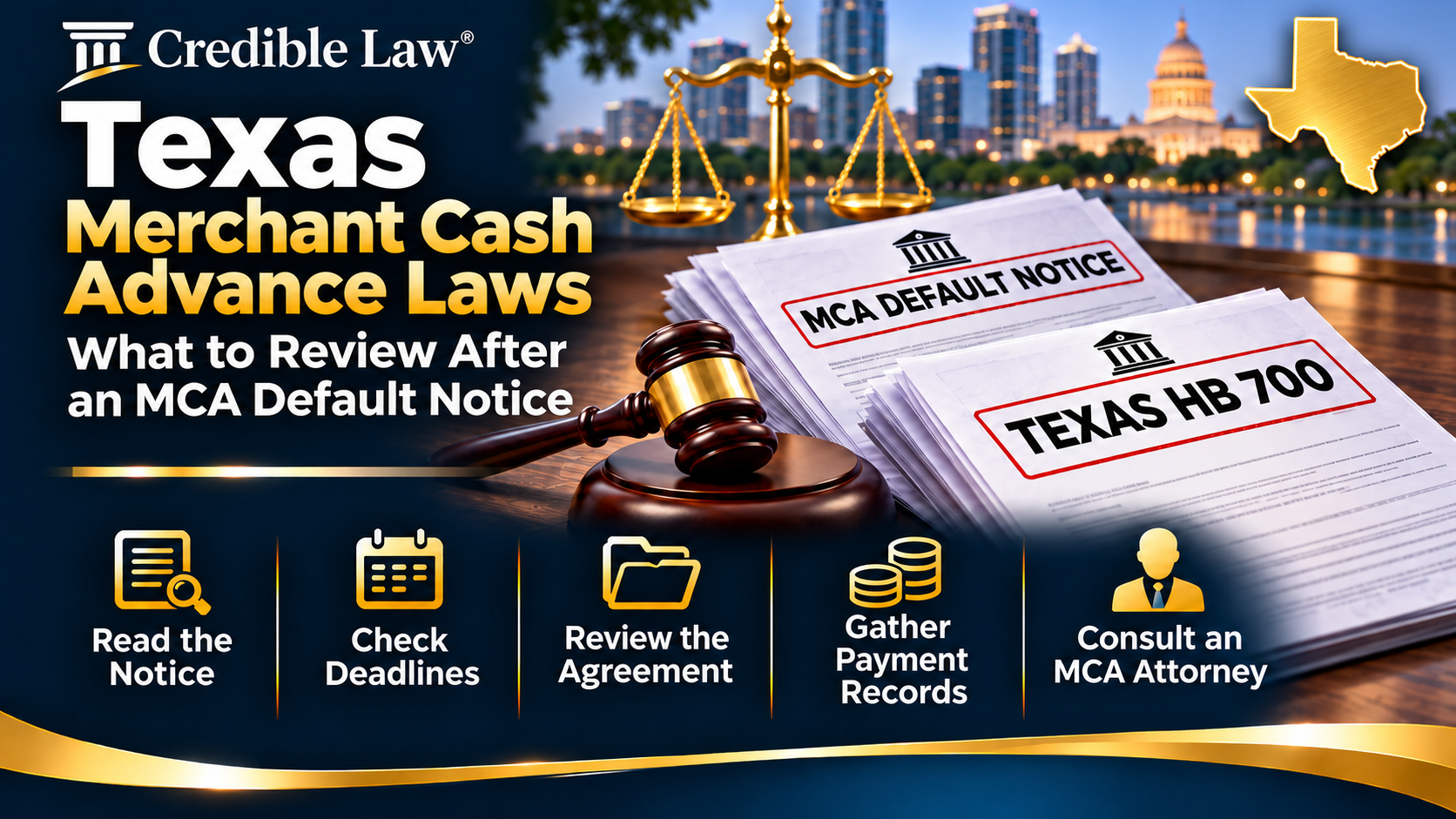
The national legal information and attorney referral network explains how Texas House Bill 700, funding agreements and court deadlines can affect the questions business owners bring to independent counsel.
SAN DIEGO, Calif. / 500NewsWire / November 24, 2026 / Credible Law is highlighting its Texas merchant cash advance resources ahead of the Dec. 31 registration deadline established by House Bill 700 for commercial sales-based financing providers and brokers operating when the law took effect. The guidance focuses on Texas business owners who have received a default notice, seen automatic withdrawals continue after a drop in sales, or been served with a merchant cash advance lawsuit.
When a funder claims a business has defaulted, the owner may need to answer several questions at once. What does the funder say triggered the default? How did it calculate the amount due? Has it filed a lawsuit, or has it sent a demand under the agreement? Credible Law’s guide to Texas merchant cash advance laws explains how the state’s sales-based financing rules and other legal considerations can come into play as a dispute progresses.
What happens when a Texas business defaults on an MCA?
The next step depends on the agreement, the alleged default and the action the funder takes. A demand may cite a returned debit, a missed remittance or another event the funder considers a breach. It may also claim that the remaining balance or additional fees are due. The business can preserve the full notice and ask for an itemized balance showing how the funder credited payments and calculated the amount it seeks.
If the business receives a summons or citation, the court documents and service details need prompt attention. Texas Rule of Civil Procedure 99 requires a citation issued under that rule to state the time for filing a written answer and warn of the possibility of a default judgment. An independent attorney can verify the deadline under the rules that apply to the case, including when the contract identifies a court outside Texas.
Where Texas House Bill 700 fits
House Bill 700 added Chapter 398 to the Texas Finance Code. For covered commercial sales-based financing, Section 398.056 restricts when a provider or broker can set up automatic debits from a recipient’s deposit account. It requires a validly perfected security interest in that account with first priority. Section 398.055 provides that a covered contract containing a confession of judgment or similar provision is void and unenforceable. Chapter 398 also states that it does not create a private right of action for compliance or noncompliance with the chapter. tcss.legis.texas.gov
For a business receiving a demand, those provisions give counsel specific issues to review. The signed agreement, its date, any renewals, the debit authorization and the records supporting the claimed security interest can all be relevant. The December registration deadline applies to providers and brokers covered by that transition provision. A business responding to a lawsuit must confirm its own deadline from the applicable court rules and case records.
Compare the default notice with the contract and sales records
Consider a Texas contractor whose customer payments slow while fixed daily debits continue. The contractor sends sales reports and asks for lower remittances. A debit later fails, and the funder issues a default notice demanding the remaining balance. In that situation, one question for counsel is whether the agreement offered a process for adjusting remittances and what happened when the business tried to use it.
That review starts with the reconciliation clause, the records the business submitted, the delivery dates and the funder’s replies. Bank statements and payment ledgers can show whether the debits changed after the request and whether the claimed balance reflects payments already made. If the notice names an owner personally, the signed guaranty gives counsel a separate document to review for the obligations the funder says the owner assumed.
Five records to gather after a Texas MCA default notice
- The complete default notice or court papers. Keep all attachments, envelopes, delivery details and any case number.
- The signed agreement and later changes. Include renewals, amendments, guaranties and debit authorizations.
- The payment history. Gather bank statements, withdrawal records and any itemized balance from the funder.
- Sales and reconciliation records. Keep the reports you supplied, the dates you sent them and the funder’s responses.
- A short timeline. Record when sales changed, when you requested an adjustment, when the funder sent its notice and when any court papers arrived.
An attorney for a merchant cash advance can use these records to identify what needs immediate attention, assess the funder’s calculation and determine which Texas rules may apply. If the parties are discussing a payment arrangement or settlement, counsel can also review how the written terms address future withdrawals, outstanding claims and any personal guaranty.
About Credible Law
Credible Law is a San Diego-based national legal information and attorney referral network. It publishes resources on merchant cash advance disputes, commercial collections and business litigation and connects business owners with independent attorneys. Legal advice and representation are provided by independent counsel through separate engagements.
Media Contact
Kevin Leonard
Credible Law
https://crediblelaw.com/
(888) 201-0441
contact@crediblelaw.com