
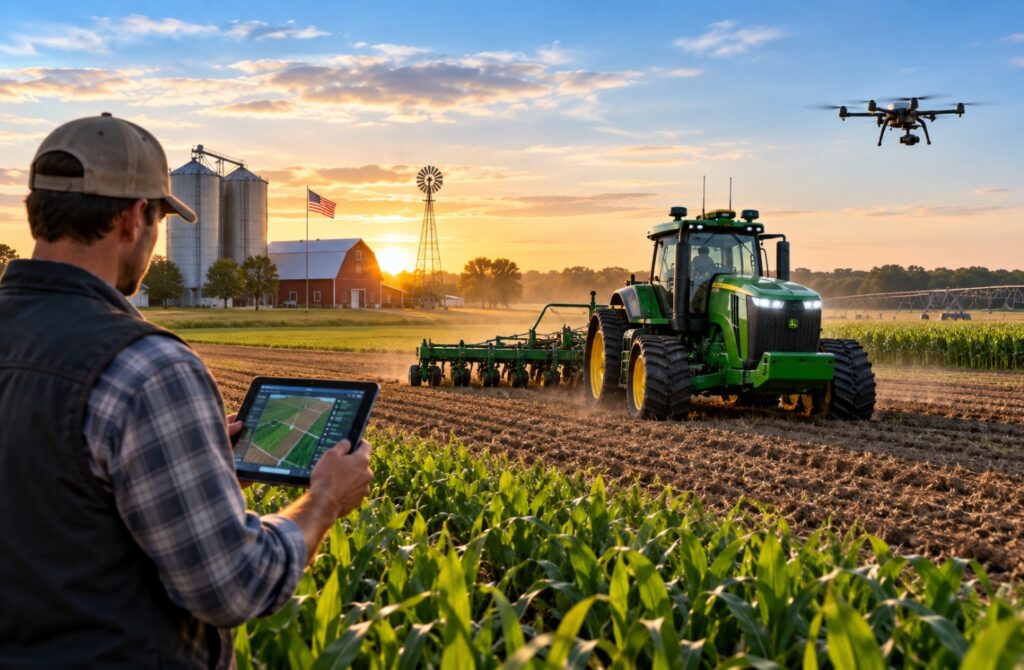
Houston, Texas / 500NewsWire / September 08, 2026 / U.S. agriculture is entering a new phase of technological change as farmers look for ways to manage labor challenges while maintaining productivity and controlling operating costs. From precision-guidance systems and automated milking equipment to robotics, sensors and artificial intelligence, automation is becoming an increasingly important part of farming operations across the country.
The shift is particularly significant for labor-intensive agricultural sectors. The U.S. Department of Agriculture’s Economic Research Service (USDA ERS) identifies labor availability, wages and the composition of the agricultural workforce as important issues affecting U.S. agriculture. Specialty crops, including fruits and vegetables, can face additional pressure because many production and harvesting activities continue to depend heavily on manual labor.
Rather than simply replacing workers, however, automation is increasingly being used to help farmers complete repetitive or physically demanding tasks while allowing employees and farm operators to focus on activities requiring experience and judgment.
Precision Technology Is Already Widely Used
Agricultural automation does not necessarily mean a completely driverless farm. Some of the most widely adopted technologies are systems that assist farmers with existing equipment.
USDA ERS reported that guidance autosteering systems were used by 52% of midsize crop farms and 70% of large-scale crop-producing farms in 2023. Adoption among small farms was considerably lower, at 9%. The systems use positioning technology to help tractors, harvesters and other equipment follow precise field paths.
These systems can help reduce overlapping passes through fields, improve operating accuracy and reduce fatigue for equipment operators. USDA research has also found that more than half of the acreage planted to corn, soybeans, winter wheat and cotton was being managed with auto-steer or guidance systems in the years covered by the agency’s earlier studies.
The differences in adoption by farm size highlight an important issue for the future of agricultural automation: technology must make economic sense for individual operations.
Specialty Crops Present a Bigger Automation Challenge
Automation can be more difficult in crops that require delicate harvesting and handling.
Fruit, vegetable, tree-nut and nursery operations often depend on workers for tasks that are difficult to mechanize. USDA’s National Institute of Food and Agriculture (NIFA) says specialty crop producers face challenges including labor shortages, global competition and demands for higher quality and environmental sustainability. Researchers are therefore developing automated systems for growing, harvesting and processing.
Some of these technologies are already demonstrating potential. USDA NIFA reports that researchers developed a machine-vision system capable of detecting apples in tree canopies and successfully picking a portion of them. Other projects have explored automated apple harvesting and targeted systems designed to improve harvesting efficiency while limiting fruit damage.
These developments illustrate why agricultural automation is unlikely to follow a single model. A system suitable for a large corn or soybean operation may not work for an orchard or vegetable farm.
Robotics Are Expanding in Dairy Farming
Automation is also changing livestock agriculture.
Robotic milking systems allow individual cows to enter automated milking stations where the milking process can be completed without the same level of manual intervention required in conventional systems.
USDA ERS research published in 2026 found that robotic milking increased dairy net returns by an average of 13% compared with nonadopters after accounting for farm and operator characteristics. The researchers also examined other precision technologies involving breeding, data support and milking.
The labor implications can vary by farm size. USDA research found that midsized dairy operations using robotic milking had lower paid labor expenses per hundredweight than comparable nonadopting farms in the 2021 data. Among smaller dairies, robotic milking was associated with lower unpaid labor expenses, although the economics of adoption differ significantly between operations.
Robotic milking was used to produce 6% of U.S. milk in 2021, compared with 4% in 2016, according to USDA ERS. Adoption was particularly notable among midsized dairy farms.
The Cost of Automation Remains a Barrier
Despite the potential benefits, automation requires investment.
Advanced equipment can involve significant costs for machinery, installation, software, maintenance and employee training. The economics can be especially challenging for smaller farms that cannot spread the cost of technology across a large number of acres or animals.
USDA data show that precision-agriculture adoption generally rises with farm size. Larger operations are often better positioned to benefit from technologies that require substantial upfront investment, while smaller operations may need lower-cost or more flexible solutions.
For farmers, the decision therefore involves more than determining whether a machine can perform a particular task. They must consider whether the technology can produce enough savings, additional productivity or operational benefits to justify the investment.
Automation Could Change Agricultural Jobs
The growing use of machines does not necessarily mean that people will disappear from agricultural operations.
Instead, automation may change the skills required from farm employees. Workers could increasingly spend time supervising equipment, maintaining automated systems, analyzing data and responding to problems rather than performing every repetitive task manually.
This transition could create greater demand for workers who understand agricultural machinery, software, sensors, GPS systems and data management.
At the same time, human experience remains essential. Weather, soil conditions, crop health and unexpected equipment problems can require decisions that automated systems are not designed to make independently.
New Technology Brings New Responsibilities
As farm equipment becomes more connected and automated, technology also introduces new considerations involving safety, data and system reliability.
Farmers using connected equipment may need to understand how operational data is collected, stored and shared. Autonomous or semi-autonomous machinery can also raise questions about equipment maintenance, operator responsibility and safety procedures.
These issues are likely to become more important as agricultural technology develops and more farm operations rely on interconnected machinery and software.
A Gradual Transformation
The automation of U.S. agriculture is unlikely to happen through a single technological breakthrough. Instead, the change is taking place through a combination of precision-guidance systems, sensors, robotics, automated livestock equipment, artificial intelligence and farm management.
Current USDA research suggests that farmers are adopting these technologies for several reasons, including saving labor time, increasing yields, reducing input costs, lowering operator fatigue and improving farm efficiency.
For U.S. farmers, the future of automation may therefore be less about replacing people and more about combining human expertise with increasingly capable technology. As labor pressures, operating costs and technological capabilities continue to evolve, farms that can identify practical and economically sustainable uses for automation may be better positioned to adapt to the changing agricultural landscape.